
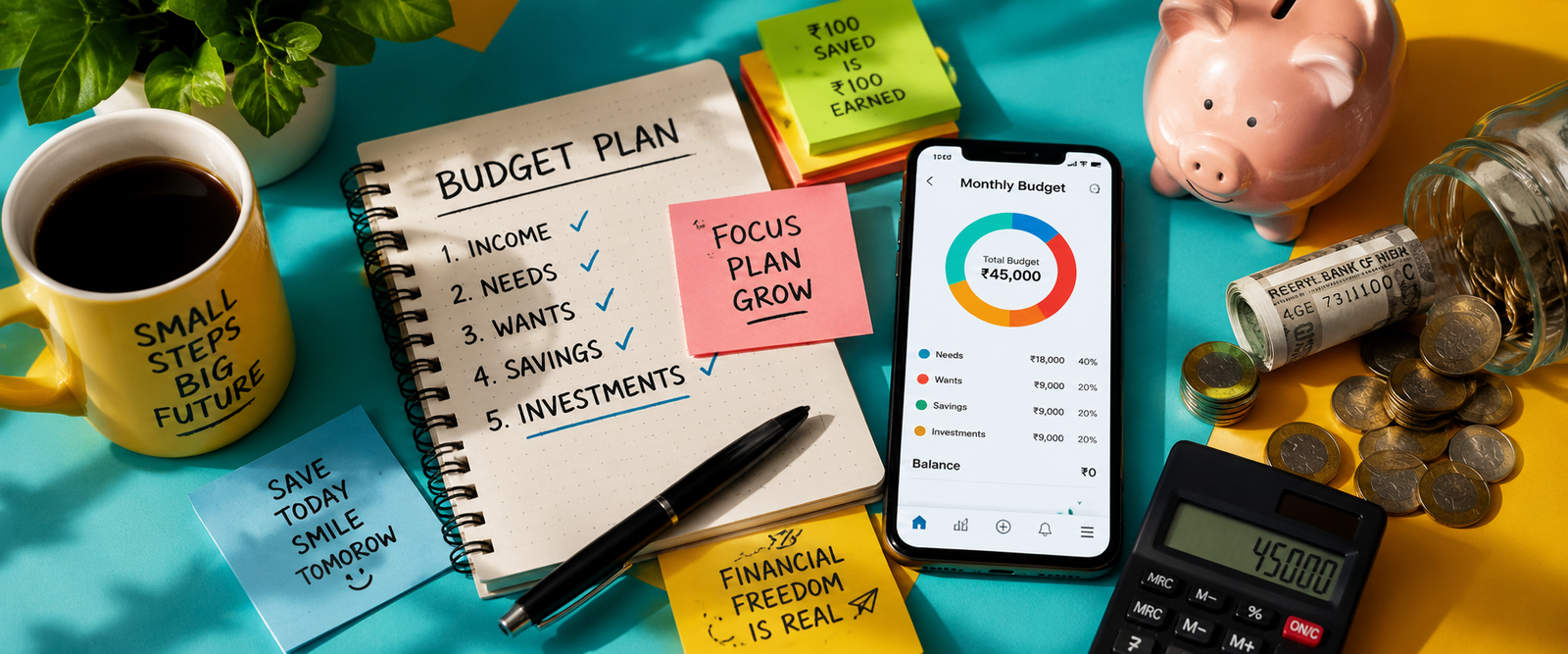
Salary day feels great. Ten days later, you’re checking your balance and wondering where it all went. Sound familiar? You’re not bad with money — you just haven’t built a monthly budget that actually works yet, one that survives contact with real life instead of falling apart by the second week.
Most people don’t fail at budgeting because they’re lazy. They fail because they build a budget once, on a spreadsheet, in a burst of motivation — and then never look at it again. A real budget isn’t a document. It’s a habit you check every few days.
Table of Contents
Why Most Budgets Fail Before They Start
The usual budget mistake is copying a template that doesn’t match your life. You block off ₹2,000 for “entertainment” without checking what you actually spent last month, and by day twelve the number is already wrong. If you want to track monthly expenses properly, you first need real numbers from your own bank statements — not guesses.
Another common trap: treating savings as whatever is “left over” at month-end. There’s usually nothing left over. That’s why separating savings from income early in the month, right after salary hits your account, changes everything.
Building a Monthly Budget That Actually Works, Step by Step
Here’s a structure that holds up in the real world, not just on paper.
- Start with your actual numbers. Pull your last two months of spending. Don’t estimate — check.
- Pick a framework, don’t invent one. The 50/30/20 rule for budgeting splits income into needs, wants, and savings, and it’s forgiving enough for beginners. If you want tighter control, zero-based budgeting for beginners gives every rupee a job before the month starts.
- Automate the savings step. Move money to savings the day salary lands, before it can quietly disappear into small daily spends. This is easier when you’re tracking progress toward savings goals rather than just watching a balance shrink.
- Build a small buffer category. One category for “unexpected stuff,” built using the same discipline behind how to stop overspending, saves your whole budget from one surprise auto-rickshaw fare or medical bill.
- Check in weekly, not monthly. A five-minute Sunday review catches slip-ups while there’s still time to course-correct.
This is the real difference between a budget that looks good on day one and a monthly budget that actually works on day twenty-five: it gets checked, not just created.
Common Mistakes That Quietly Break a Monthly Budget
Even people who mean well fall into a few repeat traps. Categories that are too broad (“miscellaneous”) hide where money is really going. Ignoring irregular expenses — annual subscriptions, festival spending, insurance premiums — means they show up as “surprise” costs every single time, even though they happen every year.
Then there’s the biggest one: no buffer for emotion-driven spending. Stress spending after a hard day at work is real, and if your budget doesn’t plan for it, it’ll blow past its limits. Fixing this habit usually matters more than picking the “perfect” budgeting method.
Making Your Monthly Budget Actually Stick
A budget that actually works isn’t the one with the fanciest spreadsheet. It’s the one you can keep using in month four, month five, and beyond. Keep your categories simple enough that updating them doesn’t feel like a chore, and keep your bigger goals in view, not just this month’s spending.
Some months will be tighter than others — a wedding, a festival, an unplanned repair. That’s fine. A good monthly budget that actually works bends without breaking; it doesn’t demand perfection, just consistency.
Start small. Pick one framework, track one month honestly, and adjust from there. That’s genuinely how a working monthly budget gets built — not in a single sitting, but one honest month at a time.
Leave a Reply