

Every month, the same routine. You open your bank app or walk into an exchange house, type in the amount, and watch a chunk of your hard-earned salary vanish into fees and bad exchange rates before it even reaches your family. ₹500 here, ₹1,200 there — it doesn’t look like much each time. But over a year, those small cuts add up to a full month’s rent. Most people never even track where this money leaks.
If you’re an Indian expat sending money home regularly, figuring out how to send money home without high fees is one of the highest-impact money moves you can make. It’s not about finding some secret loophole. It’s about knowing where the fees actually hide and choosing the right channel for how you send. Since remittances are a fixed monthly cost — often the second biggest after rent — getting this right is as important as building a budget that sticks. One wrong channel, repeated twelve times, can quietly cost you a full month’s groceries.
Table of Contents
Where the Fees Actually Hide
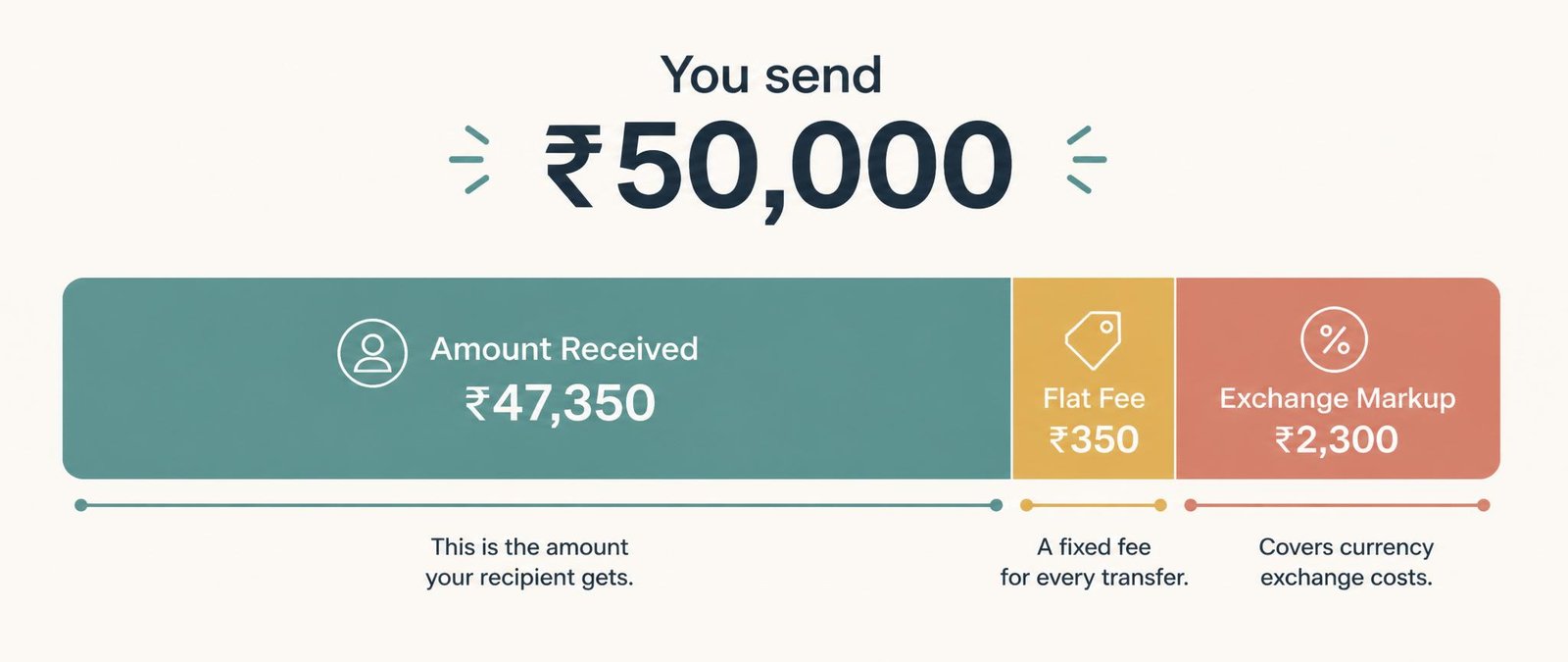
Most people focus on the flat transfer fee — the ₹100 or ₹300 the app shows upfront. That’s the visible cost. But the real money often disappears in places you’re not looking.
The Exchange Rate Markup
This is the biggest hidden cost and most people never notice it. Every transfer service sets its own exchange rate — and it’s almost never the real mid-market rate you’d find on Google or XE. The gap between their rate and the real rate is called a markup, and it can quietly cost you 1–3% on every single transfer. On a monthly remittance of ₹50,000, a 2% markup means roughly ₹1,000 lost — on top of whatever flat fee you already paid. If you’re already saving on a fixed salary, losing ₹1,000 to a markup you didn’t even see stings twice as hard.
The “Zero Fee” Trap
Some services advertise zero transfer fees. Sounds great — until you check the exchange rate they’re offering. The fee didn’t disappear. It just moved into the rate. This is one of the most common hidden fees in money transfers, and it catches people who compare services by fee alone without checking the total amount received on the other end. Knowing how to send money home without high fees starts with ignoring the advertised fee and looking only at the final received amount.
Intermediary and Receiving Bank Charges
Wire transfers through traditional banks often pass through intermediary banks. Each one can deduct a small fee before the money reaches your family’s account. Your bank charged ₹500. The intermediary took another ₹300. Your family received less than you sent, and nobody told you in advance. These hidden fees in money transfers are particularly frustrating because they’re invisible until the money lands short on the other side.
How to Send Money Home Without High Fees: What Actually Works
The good news: once you know where the costs are, avoiding them is surprisingly simple.
Compare Total Received, Not Just the Fee
Stop comparing transfer fees in isolation. The only number that matters is: how much does my family actually receive? Enter the same send amount on 3–4 services and compare what arrives on the other end. That single comparison reveals every hidden cost — markup, fees, deductions — in one honest number. This is the most reliable way to figure out how to send money home without high fees, because it strips away all the marketing noise.
Use Specialist Transfer Services Over Banks
Traditional bank wire transfers are almost always the most expensive option — high flat fees, poor exchange rates, and intermediary charges on top. Specialist services like Wise (formerly TransferWise), Remitly, or Instarem typically offer rates much closer to the real mid-market rate, with lower or no flat fees. For regular monthly remittances, the cheapest way to send money home is almost never through your bank. When you’re already working within a 50/30/20 style budget split, every ₹500 saved on a transfer is ₹500 that stays in the right bucket.
Lock In a Good Rate When It Spikes
Exchange rates fluctuate daily. Most transfer apps let you set up rate alerts — a notification when the rate crosses a threshold you set. If you’re not in a rush, waiting a few days for a favorable spike can save ₹500–₹1,500 on a single large transfer. Over a year, timing your transfers even loosely adds up to real money — and knowing what your real savings rate looks like helps you see exactly where those savings go.
Batch Instead of Dripping
Sending ₹10,000 four times a month costs more in fees than sending ₹40,000 once. If your family’s expenses allow it, batch your transfers into one or two per month instead of several small ones. Flat fees hit hardest on small, frequent sends. The money you save by batching can go straight toward building your own safety net — something most expats delay far too long.
Set Up a Recurring Transfer
Most specialist apps offer scheduled recurring transfers. This locks in a routine, saves time, and some services offer slightly better rates for auto-transfers. More importantly, it turns remittances into a predictable line item in your budget instead of a variable one.
How to Budget for Family Remittances
Knowing how to send money home without high fees is only half the picture. The other half is making remittances a structured part of your budget instead of something you figure out each month on the fly.
Sending money home isn’t an occasional expense — for most expats, it’s the single largest fixed cost after rent. Treating it like a one-off payment instead of a budget category is where things start to slip.
The smarter approach: treat remittances as a non-negotiable “bill” — just like rent or utilities. Decide the fixed amount on salary day, transfer it immediately, and budget the rest of your life around what’s left.
If remittances eat a big share of your salary, a standard budgeting framework might need adjusting. For many expats, remittances alone consume 30–40% of income. That’s fine — but you need to build the rest of your budget around that reality, not pretend it doesn’t exist.
It also helps to budget for family remittances separately from your own savings. Keep two clear numbers: what goes home, and what stays for your own goals. Mixing them together is how people end up sending everything home and building zero financial safety for themselves.
Track the True Cost Each Month
Every transfer involves a fee — visible or hidden. Add up the real cost (the difference between what you sent and what your family received) each month and include remittance fees as their own line item. You’ll quickly see which months cost more and whether switching services would save on international money transfer costs over time.
How Much Are You Really Losing? A Quick Comparison

| Transfer Method | Typical Fee | Exchange Rate Markup | Total Cost on ₹50,000 |
|---|---|---|---|
| Bank wire transfer | ₹500–₹1,500 | 1.5–3% | ₹1,250–₹3,000 |
| Specialist app (Wise, Remitly) | ₹0–₹300 | 0.3–0.7% | ₹150–₹650 |
| Exchange house (walk-in) | ₹0–₹200 | 1–2.5% | ₹500–₹1,450 |
| PayPal / traditional fintech | ₹0–₹100 | 2.5–4% | ₹1,250–₹2,100 |
The difference between the best and worst option can be ₹2,000+ per transfer. Over 12 months, that’s ₹24,000 — enough to cover an entire month of groceries or kickstart a proper safety net.
Don’t Let Fees Eat What You Worked For
Learning how to send money home without high fees isn’t a one-time decision. It’s a monthly habit — comparing services, checking the rate, batching transfers, and treating remittance cost as a visible budget line instead of an invisible leak.
The money you save isn’t theoretical. It’s real cash that stays in your family’s hands instead of disappearing into markups and processing charges. Pick the cheapest way to send money home based on what your family actually receives, not what the app advertises. Save on international money transfer costs by batching, timing, and using specialist services. And budget for family remittances as a fixed, non-negotiable category — not something you figure out on the fly.
Every rupee you stop losing to fees is a rupee that actually reaches the people you’re working so hard for. That’s worth the ten minutes it takes to compare.
Leave a Reply