

You’ve probably seen both terms thrown around like they mean the same thing. “Use a budget planner.” “Get a budget tracker.” So which one do you actually need — and are they even different?
They are, and the difference matters more than it sounds. One looks forward; the other looks back. It’s often the missing piece for people whose budgets quietly fall apart despite genuine effort. Getting them confused is a quiet reason people feel like they’re “budgeting” without ever getting ahead. Understanding budget planner vs budget tracker — what each does, and why you probably need both — is the difference between a plan that stays on paper and one that actually changes your money.
Table of Contents
Budget Planner vs Budget Tracker: The Core Difference
Here’s the simplest way to hold the distinction in your head:
A budget planner is about the future. It’s where you decide, in advance, how your money should be spent — ₹15,000 for rent, ₹8,000 for food, ₹5,000 to savings. It’s the plan.
A budget tracker is about the past. It’s where you record what actually happened — what you really spent, category by category, after the fact. It’s the reality check.
Put simply, the whole budget planner vs budget tracker question comes down to intention versus reality. A planner sets the target. A tracker tells you whether you hit it. Frame it as budget tracker vs planner and the point is the same — one without the other is half a system, and half a system is why most budgets fail.
What a Budget Planner Actually Does
So what is a budget planner, exactly? It’s where budgeting begins. Before a single rupee moves, you’re deciding where it’s supposed to go.
The difference between planning and tracking starts here: planning is proactive. You’re assigning every rupee a job in advance, which is the entire idea behind a monthly budget that actually works. A good plan answers questions like:
- How much goes to needs, wants, and savings this month?
- What’s my spending limit in each category?
- How much am I setting aside before I’m allowed to spend?
A planner is especially powerful at the start of the month, or right when your salary lands. It’s where frameworks live — deciding to follow the 50/30/20 budgeting method, for instance, is a planning decision. Without a plan, you’re just spending and hoping. The plan turns hope into intention.
But here’s the catch: a plan is only a guess until reality tests it. And that’s where the other half comes in.
What a Budget Tracker Actually Does
A budget tracker is where the truth shows up. It records what you actually spent — not what you intended to spend. If the planner is the intention, the tracker is the receipt, and the difference between planning and tracking is exactly that gap.
This is where most people discover the uncomfortable gap between plan and reality. You budgeted ₹8,000 for food; the tracker says ₹11,500. That gap is the single most useful piece of information in your entire financial life, because you can’t fix a leak you can’t see. Learning to track your monthly expenses is what turns a vague sense of “I overspend” into a specific, fixable number.
A budget tracker vs planner comparison really comes down to this: the tracker is your feedback loop. It catches the small leaks — the extra deliveries, the forgotten subscriptions, the cash that vanishes — that a plan alone will never reveal. Without tracking, your budget is a New Year’s resolution: well-intentioned and quietly abandoned, which is exactly why willpower alone isn’t enough to keep a budget running.
Why You Actually Need Both
So do you need both? Here’s the part most people miss. Budget planner vs budget tracker isn’t a choice — it’s a cycle. They’re two halves of the same loop:
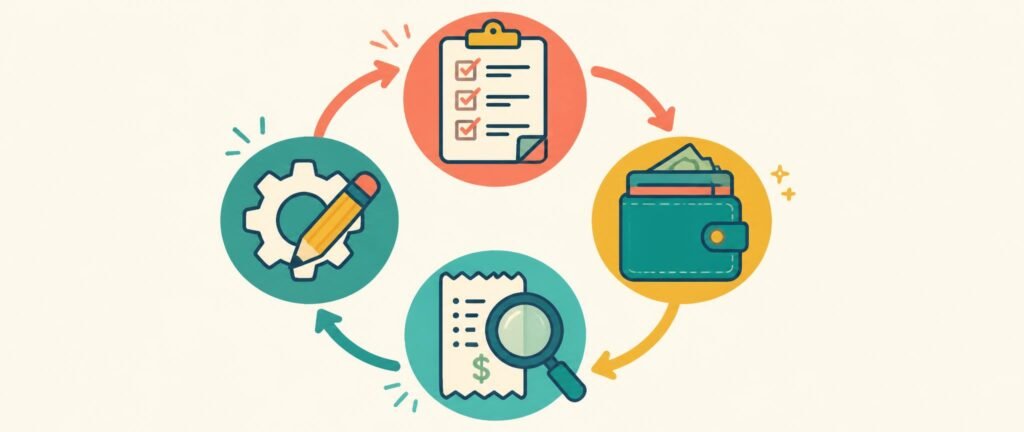
- Plan — decide where your money should go (planner)
- Spend — live your month
- Track — record what actually happened (tracker)
- Adjust — use the gap to plan better next month
Skip the plan, and you’re tracking with no target — just recording numbers with no way to know if they’re good or bad. Skip the tracking, and your plan never meets reality, so it never improves. You need both for the loop to close.
| Budget Planner | Budget Tracker | |
|---|---|---|
| Direction | Forward (future) | Backward (past) |
| Question | Where should money go? | Where did money go? |
| Best used | Start of month / payday | Daily / weekly |
| Job | Sets the target | Reveals the reality |
| Without it | You spend blindly | Your plan never improves |
The magic isn’t in either tool alone. It’s in the gap between them — the space between what you planned and what you did. That gap is where every real improvement in your finances actually happens.
How to Use Both Without Overcomplicating It
The good news: you don’t need two separate systems. The best tools combine both — a place to set your plan and a place to log reality, side by side.

Plan once a month. On payday, decide your category limits and move savings first. Five minutes.
Track as you go. Log spends daily — thirty seconds each — so nothing slips through. This is the habit that actually matters, because a good tool makes tracking automatic instead of effortful.
Review weekly. Compare plan to reality. Where’s the gap? That’s your one adjustment for next week.
Adjust the plan monthly. Use last month’s tracking to set a more realistic plan. Over a few months, plan and reality start to converge — and that’s when budgeting finally feels easy.
The whole loop takes maybe ten minutes a week once it’s running. The tool should make it feel like one smooth process, not two separate chores.
The Simple Setup: Plan and Track in One Place
If juggling a separate planner and tracker sounds like too much, that’s a fair concern — and it’s exactly why the best modern tools do both. Holy Budget was built around this loop: you set your category plan, log your actual spending, and see the gap between the two in one place, on any device, for free.
Instead of a planning spreadsheet in one tab and a tracking app on your phone, it keeps the whole cycle — plan, spend, track, adjust — in a single simple tool. That’s the version most people actually stick with, because the friction of switching between two systems is usually what kills the habit.
Plan Forward, Track Backward, Improve Every Month
The budget planner vs budget tracker question has a clear answer: it was never either/or. The difference between planning and tracking is simply direction — a planner sets your intentions; a tracker checks them against reality; and the gap between the two is where your money actually improves.
Plan at the start of the month. Track as you spend. Review the gap weekly. Adjust next month’s plan accordingly. Do that for three months and budgeting stops being a source of stress — it becomes a quiet, self-correcting system that gets a little more accurate every single time.
Leave a Reply