
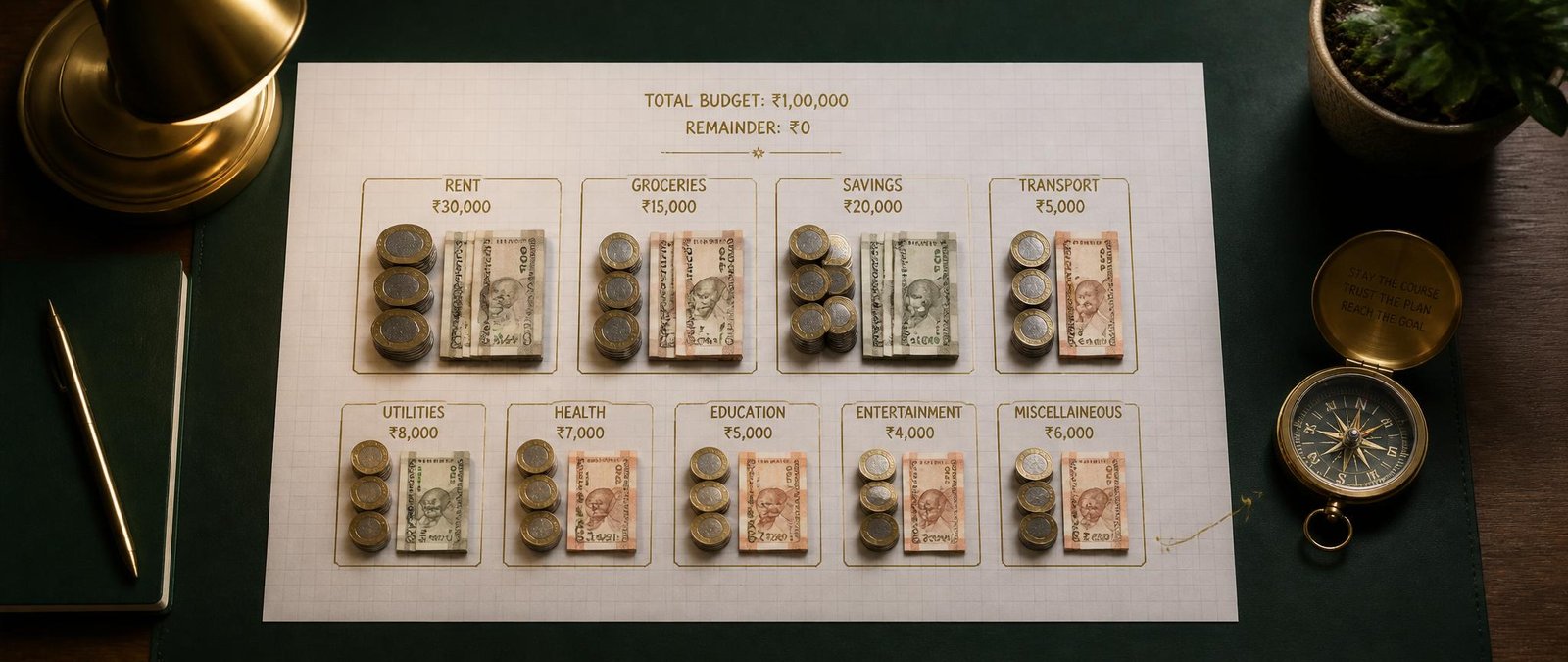
You get your salary, pay the essentials, and somehow the rest just… disappears. No big purchase to blame, no obvious leak — it’s just gone. If that’s a familiar feeling, zero based budgeting for beginners is worth learning, because it fixes exactly this problem: money vanishing without a name attached to it.
Unlike percentage-based systems like the 50/30/20 budgeting split, zero based budgeting doesn’t use fixed ratios at all. Every rupee gets assigned a job before the month even starts. Here’s how it actually works, and how to set one up this week.
Table of Contents
What Is Zero Based Budgeting for Beginners?
Zero based budgeting means your income minus your planned spending equals zero. Not because you spend everything carelessly, but because every rupee — including savings — has a specific purpose written down in advance.
Income − Expenses − Savings = ₹0
That “zero” isn’t a warning sign. It’s the goal. Nothing sits around unlabeled, waiting to be spent on something random come the 25th of the month.
How the Zero Based Budget Method Works: Give Every Rupee a Job
The core idea is simple: before the month begins, you allocate every rupee of income to a specific job. Not roughly — specifically.
Here’s the basic process:
- List your total monthly income — salary, freelance income, side hustle money, everything
- List every expense category — rent, groceries, EMIs, insurance, subscriptions, entertainment, savings, investments
- Assign a rupee amount to each category until your income minus all categories equals zero
- Track spending against each category through the month
- Adjust next month based on where you overspent or underspent
If you’ve never tried logging daily household spending before, this is where the habit becomes essential — you can’t assign a job to every rupee if you don’t know where your rupees are actually going right now.
A Real Example: Zero Based Budget on a ₹35,000 Salary
Numbers make the whole idea click faster than theory. Say your take-home pay is ₹35,000 a month.
| Category | Amount |
|---|---|
| Rent | ₹12,000 |
| Groceries | ₹5,000 |
| Utilities & phone | ₹1,500 |
| Transport | ₹2,000 |
| EMI | ₹4,000 |
| Emergency fund | ₹3,000 |
| Investments (SIP) | ₹4,000 |
| Entertainment & eating out | ₹2,500 |
| Miscellaneous | ₹1,000 |
| Total | ₹35,000 |
Every rupee has a home. Nothing is floating around waiting to be “figured out later” — which is usually exactly when overspending sneaks in. Notice, too, that building a financial safety net gets its own dedicated line above, not whatever happens to be left after everything else.
Zero Based Budgeting vs the 50/30/20 Rule
People often ask which one is better. Honestly, it depends on how much control you want.
- 50/30/20 uses fixed percentages — 50% needs, 30% wants, 20% savings — and is faster to set up
- Zero based budgeting goes category by category, giving you far more precision on exactly where each rupee goes
If broad buckets feel too loose for you, or you’ve tried saving on a fixed monthly income using percentages and still felt out of control, zero based budgeting for beginners gives you the granular map that a percentage split simply can’t. It also makes it much easier to see your percentage of income saved each month, since savings sit in their own labeled category instead of whatever’s left over.
Step-by-Step: Setting Up Your First Zero Based Budget
Getting started with zero based budgeting for beginners feels intimidating for exactly one day. After that, it’s routine.
- Week 1: Write down every expense category you can think of, even small ones like chai stalls or app subscriptions
- Week 1: Pull your last two months of bank statements to see your real historical spending, not your guessed spending
- Before payday: Assign every rupee of your expected income to a category, right down to zero
- Throughout the month: Log expenses daily against the matching category so nothing gets missed
- End of month: Compare planned versus actual, and rebuild next month’s categories based on what you learned
This is one area where budgeting for beginners in India especially benefits from doing the math on paper or in a tracker first, since irregular expenses like festivals, family functions, or annual insurance premiums easily get forgotten otherwise.
Common Mistakes Beginners Make
A handful of slip-ups show up again and again with this method:
- Forgetting irregular expenses. Annual costs like insurance or festival spending need a monthly category too, even if you don’t pay them every month.
- Being too rigid. If groceries run over by ₹500 one month, move money from another category instead of abandoning the whole system.
- Skipping the savings category. Savings need their own line item just like rent does — treat it as non-negotiable, not leftover.
- Not reviewing monthly. A zero based budget that’s never updated stops reflecting your actual life within a few months.
Checking whether your savings percentage is actually growing month to month is a good way to sanity-check whether your categories are working, rather than just feeling organized on paper.
Is Zero Based Budgeting Right for You?
This method suits people who like detail and control, who’ve tried looser budgets before and watched money slip through anyway, or who have irregular expenses that a simple percentage split doesn’t capture well.
It takes more upfront effort than a percentage-based rule. But for many beginners in India dealing with a mix of fixed EMIs, family obligations, and irregular costs, that extra structure is exactly what makes a budget finally stick, since every rupee already has an assigned purpose instead of competing for whatever’s left.
Give every rupee a job for one month and see how it feels. That’s really the entire practice behind zero based budgeting for beginners — you can always simplify later, but starting detailed usually teaches you more about your own spending than starting loose ever will.
Leave a Reply